Simulate rate limiting on GitHub APIs
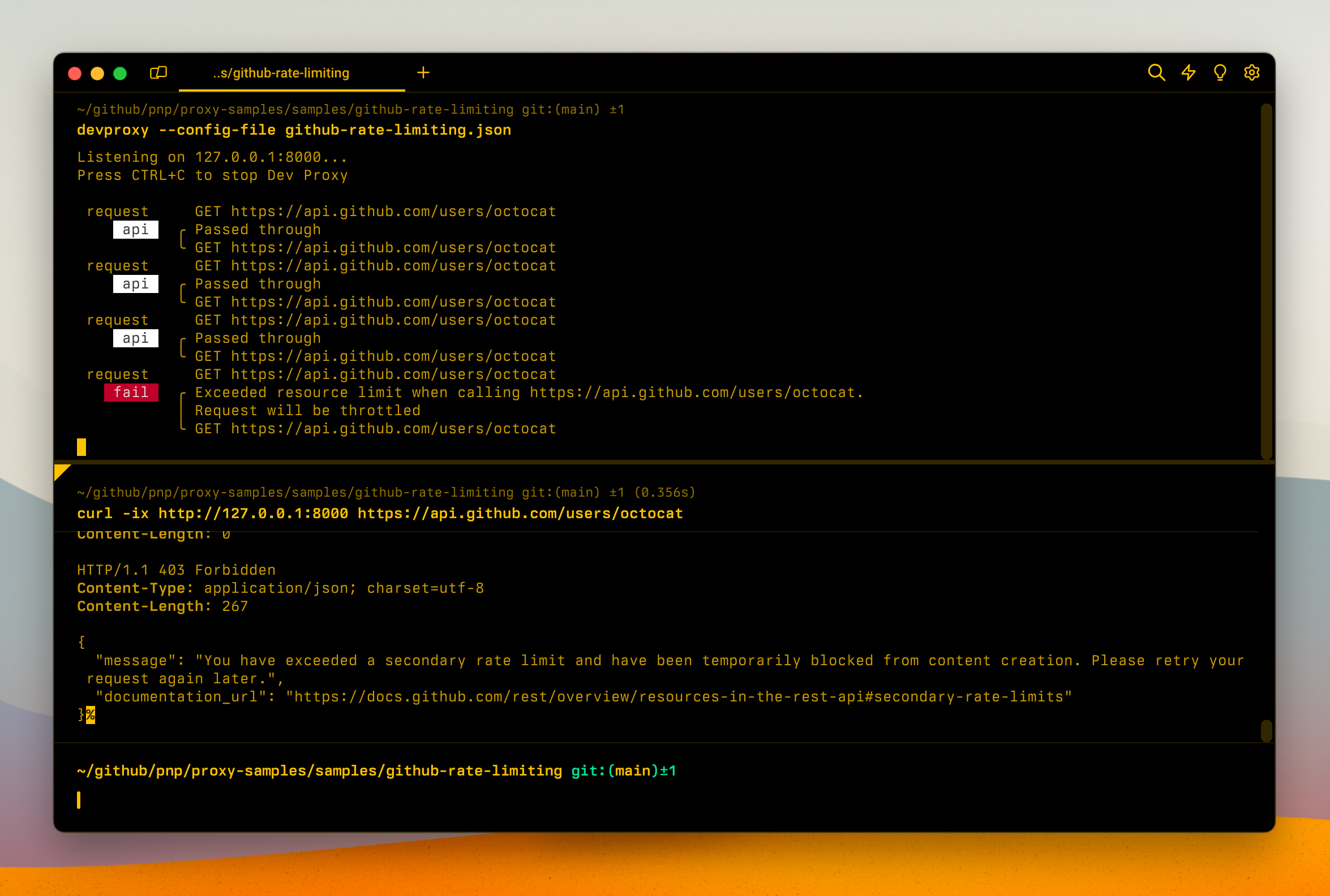
This sample contains a preset to simulate rate limiting on GitHub APIs. GitHub APIs support rate limiting, which is a mechanism that informs developers of the available server resources and allows them to increase the data throughput by staying under the rate limits and avoiding throttling.

Simulate rate limiting on GitHub APIs
Summary
This sample contains a preset to simulate rate limiting on GitHub APIs.
Your GitHub script, bot, or integration works until it hits GitHub’s rate limit: 60 requests per hour without authentication, or 5,000 with a personal access token. Then GitHub answers with a 403 or 429, and code that doesn’t read the x-ratelimit-* headers fails or keeps retrying.
Using this preset, you can see what your code does at the limit without using up your real one. Dev Proxy counts your requests to api.github.com, returns the x-ratelimit-limit, x-ratelimit-remaining, and x-ratelimit-reset headers, and answers with a 429 after 60 requests. Your code keeps calling the real GitHub API URLs.
Compatibility
Contributors
Version history
| Version | Date | Comments |
|---|---|---|
| 1.25 | October 3, 2026 | Rewrote the summary around the problem the preset solves, added devproxy config get steps |
| 1.24 | October 3, 2026 | Aligned with GitHub primary rate limit response, added RetryAfterPlugin and secondary rate limit config |
| 1.23 | September 28, 2026 | Updated to Dev Proxy v3.3.1 |
| 1.22 | July 1, 2026 | Updated to Dev Proxy v3.1.0 |
| 1.21 | June 17, 2026 | Updated to Dev Proxy v3.0.1 |
| 1.11 | May 30, 2026 | Updated to Dev Proxy v3.0.0 |
| 1.10 | March 26, 2026 | Updated to Dev Proxy v2.3.0 |
| 1.9 | March 11, 2026 | Updated to Dev Proxy v2.2.0 |
| 1.8 | February 4, 2026 | Updated to Dev Proxy v2.1.0 |
| 1.7 | January 18, 2026 | Moved config files to .devproxy folder |
| 1.6 | January 5, 2026 | Updated to Dev Proxy v2.0.0 |
| 1.5 | June 27, 2025 | Updated to Dev Proxy v0.29.2 |
| 1.4 | January 17, 2024 | Updated plugin path |
| 1.3 | January 11, 2024 | Updated to new format |
| 1.2 | December 22, 2023 | Updated to new format |
| 1.1 | November 14, 2023 | Renamed to Dev Proxy |
| 1.0 | September 16, 2023 | Initial release |
Minimal path to awesome
- Get the sample:
-
Download just this sample:
npx gitload-cli https://github.com/pnp/proxy-samples/tree/main/samples/github-rate-limitingor
-
Download as a .ZIP file and unzip it, or
-
Clone this repository
-
- Start Dev Proxy by running
devproxyin the sample’s folder
Alternatively, download the preset with Dev Proxy and start it from any folder:
devproxy config get github-rate-limiting
devproxy --config-file "~dataFolder/configs/github-rate-limiting/.devproxy/devproxyrc.json"-
Send more than 60 requests to the GitHub API, for example:
curl -ikx http://127.0.0.1:8000 https://api.github.com/users/octocat
To simulate GitHub’s secondary rate limits instead, start Dev Proxy by running devproxy --config-file .devproxy/devproxyrc-secondary.json.
Features
This preset simulates rate limiting on GitHub APIs.
Using this sample you can use Dev Proxy to:
- Simulate GitHub’s primary rate limit of 60 requests per hour. Each response includes the
x-ratelimit-limit,x-ratelimit-remaining, andx-ratelimit-resetheaders. After you exceed the limit, Dev Proxy returns a429 Too Many Requestsresponse with theAPI rate limit exceededmessage that GitHub sends. - Detect when your app retries a request before the rate limit resets, using the
RetryAfterPlugin. - Simulate GitHub’s secondary rate limits, using the
devproxyrc-secondary.jsonconfig. Dev Proxy randomly returns a429 Too Many Requestsresponse with aretry-afterheader and detects when your app retries too early.
For more information about GitHub API rate limits, see Rate limits for the REST API.
For more information about the configuration options, see the documentation of the RateLimitingPlugin, RetryAfterPlugin, and GenericRandomErrorPlugin.
Help
We do not support samples, but this community is always willing to help, and we want to improve these samples. We use GitHub to track issues, which makes it easy for community members to volunteer their time and help resolve issues.
You can try looking at issues related to this sample to see if anybody else is having the same issues.
If you encounter any issues using this sample, create a new issue.
Finally, if you have an idea for improvement, make a suggestion.
Disclaimer
THIS CODE IS PROVIDED AS IS WITHOUT WARRANTY OF ANY KIND, EITHER EXPRESS OR IMPLIED, INCLUDING ANY IMPLIED WARRANTIES OF FITNESS FOR A PARTICULAR PURPOSE, MERCHANTABILITY, OR NON-INFRINGEMENT.