Twilio API resilience testing
Test how your app handles Twilio API errors, rate limiting, and slow responses using Dev Proxy

Twilio API resilience testing
Test how your app handles Twilio API errors, rate limiting, and slow responses using Dev Proxy
Summary
Test how your app handles Twilio API errors, rate limiting, and slow responses using Dev Proxy. This sample complements the twilio-api-mocks sample by adding chaos engineering capabilities that help you build more resilient communication integrations.
Compatibility
Contributors
Version history
| Version | Date | Comments |
|---|---|---|
| 1.0 | January 19, 2026 | Initial release |
Minimal path to awesome
-
Get the sample:
-
Download just this sample:
npx gitload-cli https://github.com/pnp/proxy-samples/tree/main/samples/twilio-resilience-testingor
-
Download as a .ZIP file and unzip it, or
-
Clone this repository
-
-
Start Dev Proxy:
devproxy -
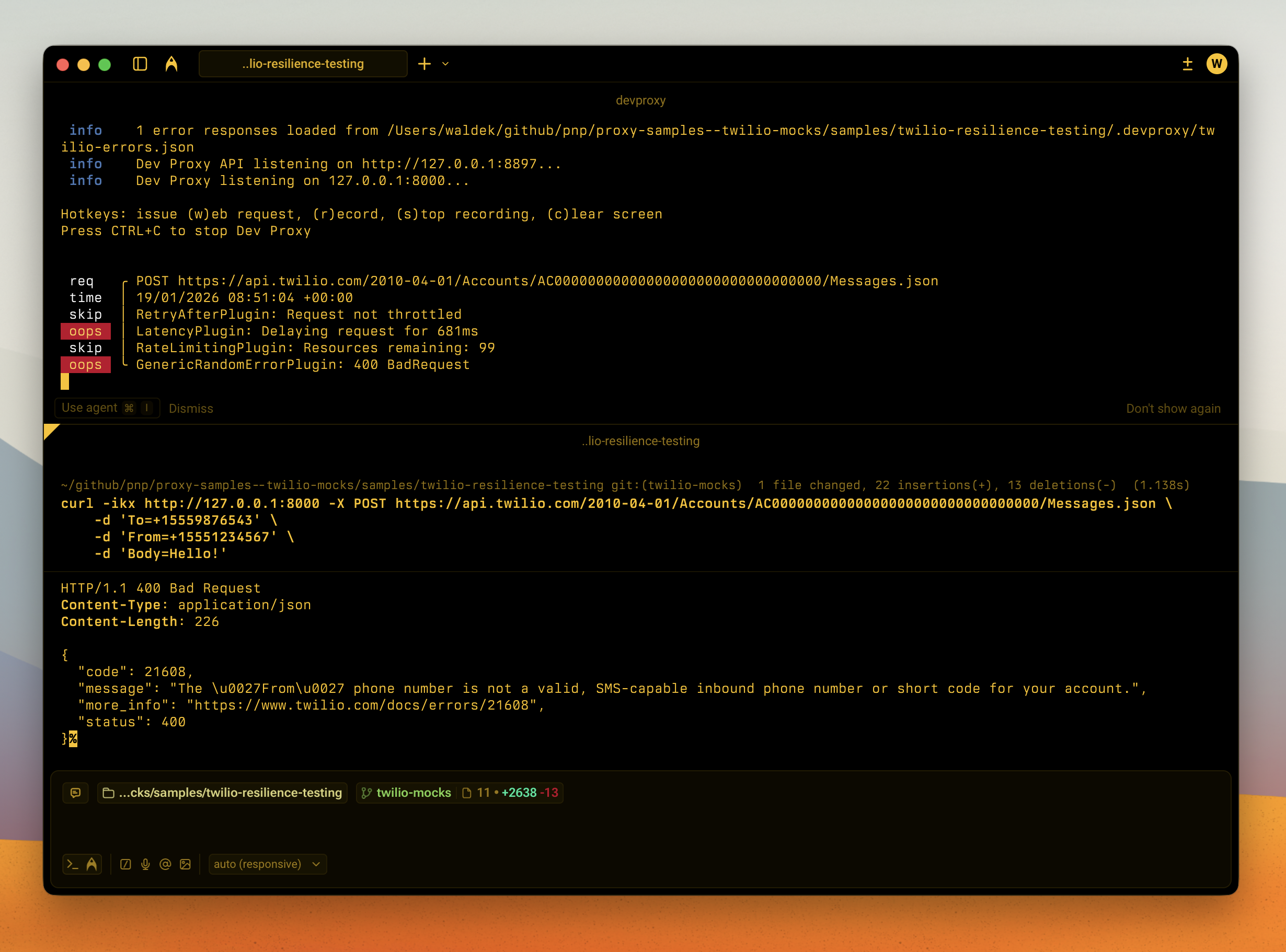
Make requests to the Twilio API through the proxy to see random errors:
# Try sending a message - may get authentication errors, invalid phone, etc.
curl -ikx http://127.0.0.1:8000 -X POST https://api.twilio.com/2010-04-01/Accounts/AC00000000000000000000000000000000/Messages.json \
  -d 'To=+15559876543' \
  -d 'From=+15551234567' \
  -d 'Body=Hello!'

# Try making a call - may get various errors
curl -ikx http://127.0.0.1:8000 -X POST https://api.twilio.com/2010-04-01/Accounts/AC00000000000000000000000000000000/Calls.json \
  -d 'To=+15559876543' \
  -d 'From=+15551234567' \
  -d 'Url=http://example.com/twiml'

# Run multiple requests quickly to trigger rate limiting
for i in {1..150}; do curl -ikx http://127.0.0.1:8000 https://api.twilio.com/2010-04-01/Accounts/AC00000000000000000000000000000000.json; done
Features
This sample simulates realistic failure scenarios for the Twilio API:
Latency simulation
All requests are delayed between 200ms and 1500ms to simulate real-world network conditions and slow API responses.
Rate limiting
The proxy simulates Twilio’s rate limiting behavior:
- Limit: 100 requests per second
- Returns
429 Too Many Requestswith proper Twilio error format when exceeded - Includes
Retry-Afterheader
Random error injection (50% failure rate)
Authentication errors (401)
20003- Authentication required
Request errors (400)
21211- Invalid phone number21602- Message body required21608- From phone number not verified30004- Message blocked
Authorization errors (403)
20005- Account not active
Not found errors (404)
20404- Resource not found
Server errors (500, 503)
20500- Internal server error20503- Service unavailable (withRetry-Afterheader)
Configuration
Adjusting the failure rate
Change the error rate in .devproxy/devproxyrc.json:
"twilioErrors": {
  "rate": 50  // Percentage of requests that will fail (0-100)
}
Adjusting latency
Modify the latency range:
"latencyPlugin": {
  "minMs": 200,
  "maxMs": 1500
}
Adjusting rate limits
Configure rate limiting behavior:
"rateLimitingTwilio": {
  "rateLimit": 100,             // Requests allowed per window
  "resetTimeWindowSeconds": 1   // Window duration
}
Use cases
This sample is useful for:
- Building resilient communication flows - Test retry logic, error handling, and user-facing error messages
- CI/CD pipeline testing - Verify your app handles Twilio failures gracefully
- Load testing - Simulate rate limiting before hitting production limits
- Chaos engineering - Randomly inject failures to find weak points
- Developer training - Help developers understand Twilio error responses
Complementing twilio-api-mocks
The twilio-api-mocks sample is great for:
- ✅ Happy path testing with mock responses
- ✅ Offline development without Twilio credentials
- ✅ Consistent, predictable API responses
This Dev Proxy sample adds:
- ✅ Random error injection
- ✅ Latency simulation
- ✅ Rate limiting simulation
- ✅ Chaos engineering scenarios
Use both together for comprehensive Twilio integration testing!
Help
We do not support samples, but this community is always willing to help, and we want to improve these samples. We use GitHub to track issues, which makes it easy for community members to volunteer their time and help resolve issues.
You can try looking at issues related to this sample to see if anybody else is having the same issues.
If you encounter any issues using this sample, create a new issue.
Finally, if you have an idea for improvement, make a suggestion.
Disclaimer
THIS CODE IS PROVIDED AS IS WITHOUT WARRANTY OF ANY KIND, EITHER EXPRESS OR IMPLIED, INCLUDING ANY IMPLIED WARRANTIES OF FITNESS FOR A PARTICULAR PURPOSE, MERCHANTABILITY, OR NON-INFRINGEMENT.