Simulate combined token and request rate limiting for LLM applications
This sample demonstrates how to combine the LanguageModelRateLimitingPlugin and RateLimitingPlugin to simulate realistic throttling scenarios that developers encounter when building applications that use language models (LLMs) in production. The sample includes an interactive AI Code Review Assistant demo app that uses GitHub Models API for code analysis and a mock API for fetching code snippets. Run it with 'npx http-server' to see both rate limiting types in action. Perfect for testing how your application handles token limits, request limits, or both simultaneously. Includes aggressive limiting config for quick testing and stress-test functionality.

Simulate combined token and request rate limiting for LLM applications
Summary
This sample demonstrates how to combine the LanguageModelRateLimitingPlugin and RateLimitingPlugin to simulate realistic throttling scenarios that developers encounter when building applications that use language models (LLMs) in production. The sample includes:
- Token-based rate limiting for GitHub Models API (using
LanguageModelRateLimitingPlugin) - Request-based rate limiting for a mock API (using
RateLimitingPlugin) - Interactive demo app - an AI Code Review Assistant that showcases both rate limiting types in action
This combination helps developers test their applications’ resilience when:
- LLM API token quotas are exceeded
- Supporting API request limits are reached
- Both types of limits are hit simultaneously
Compatibility
Contributors
Version history
| Version | Date | Comments |
|---|---|---|
| 1.3 | February 4, 2026 | Updated to Dev Proxy v2.1.0 |
| 1.2 | January 18, 2026 | Moved config files to .devproxy folder |
| 1.1 | January 5, 2026 | Updated to Dev Proxy v2.0.0 |
| 1.0 | January 3, 2026 | Initial release |
Minimal path to awesome
Prerequisites
-
Get a GitHub Token (for GitHub Models API):
The easiest way is to use this pre-filled link that creates a token with the correct permissions:
Or create one manually:
- Go to GitHub Settings → Developer settings → Personal access tokens → Fine-grained tokens
- Click Generate new token
- Give it a name (e.g., “GitHub Models token”)
- Set an expiration
- Under Permissions → Account permissions, find Models and set it to Read
- Click Generate token and copy the token
Note: The token needs the
models:readpermission to access GitHub Models. -
Install Dev Proxy if you haven’t already:
Run the Demo
1. Start Dev Proxy with aggressive limiting to quickly trigger rate limits:
cd samples/llm-combined-rate-limiting
devproxy --config-file .devproxy/aggressive-limiting.json
Dev Proxy automatically registers as a system proxy when started.
2. Start the demo app:
npx http-server -p 30003. Open the app at http://localhost:3000
4. Try the demo:
- Enter your GitHub token in the token field
- Click “Fetch Snippets” to load code samples (tests API rate limiting)
- Select a snippet and click “Review with AI” (tests LLM token rate limiting)
- Click “Review All (stress test)” to rapidly hit both rate limits!
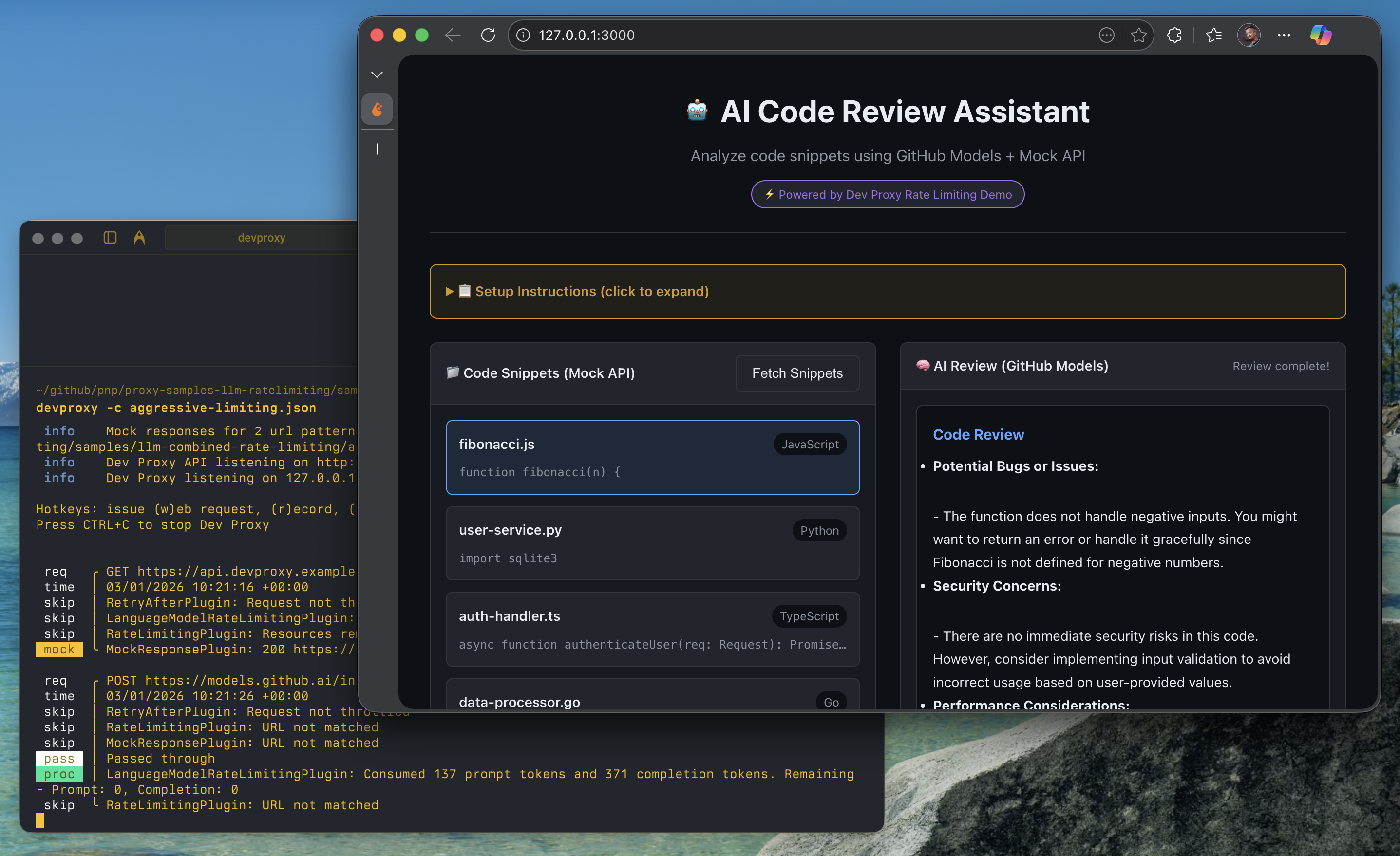
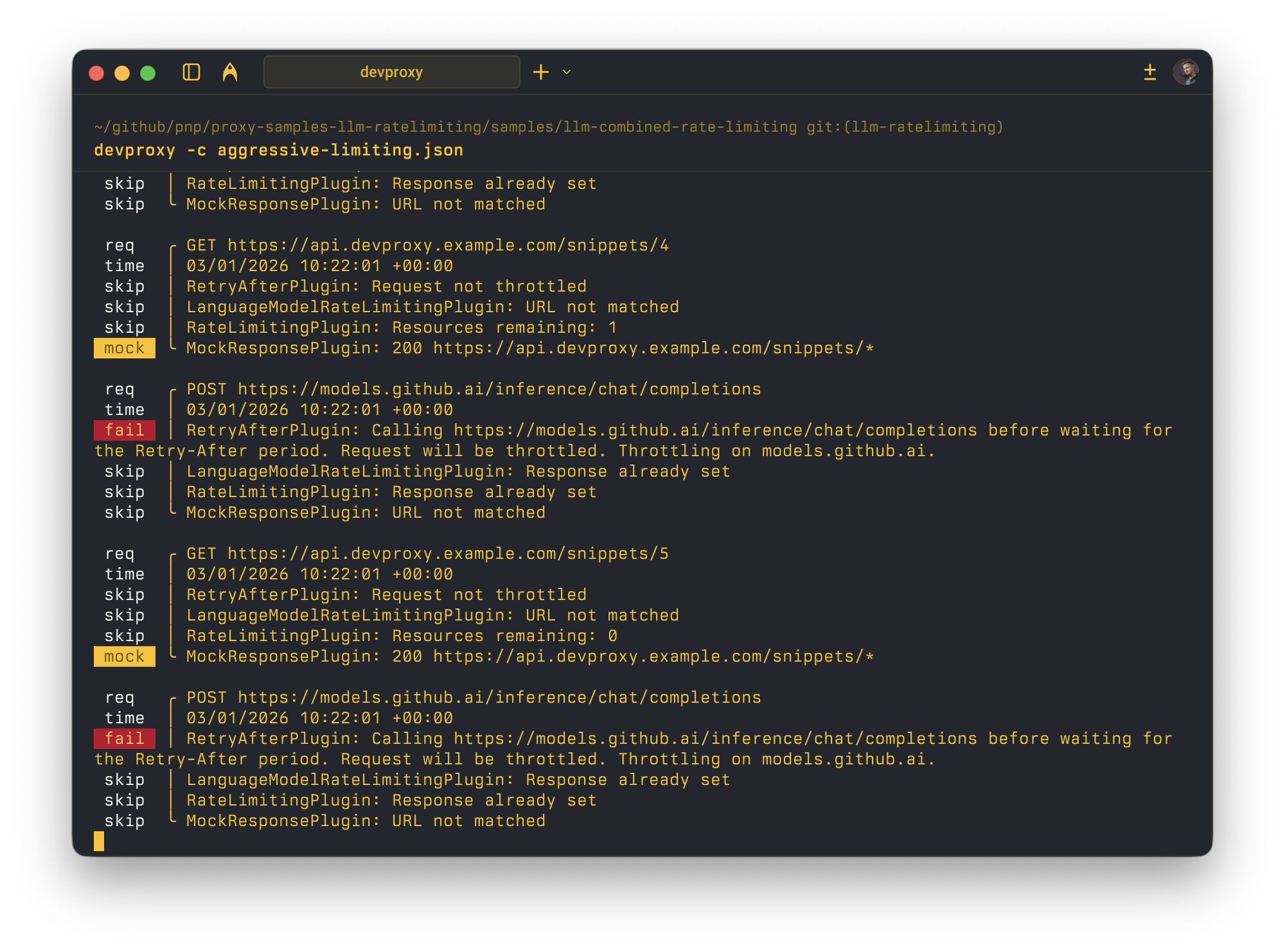
5. Watch the Dev Proxy console to see requests being intercepted and rate limits being applied
Demo App Features
The AI Code Review Assistant demonstrates a real-world scenario where an application:
- Fetches code snippets from a mock API (
api.devproxy.example.com) - Sends code to an LLM for analysis (GitHub Models at
models.github.ai) - Displays results to the user with real-time rate limit status
Screenshots
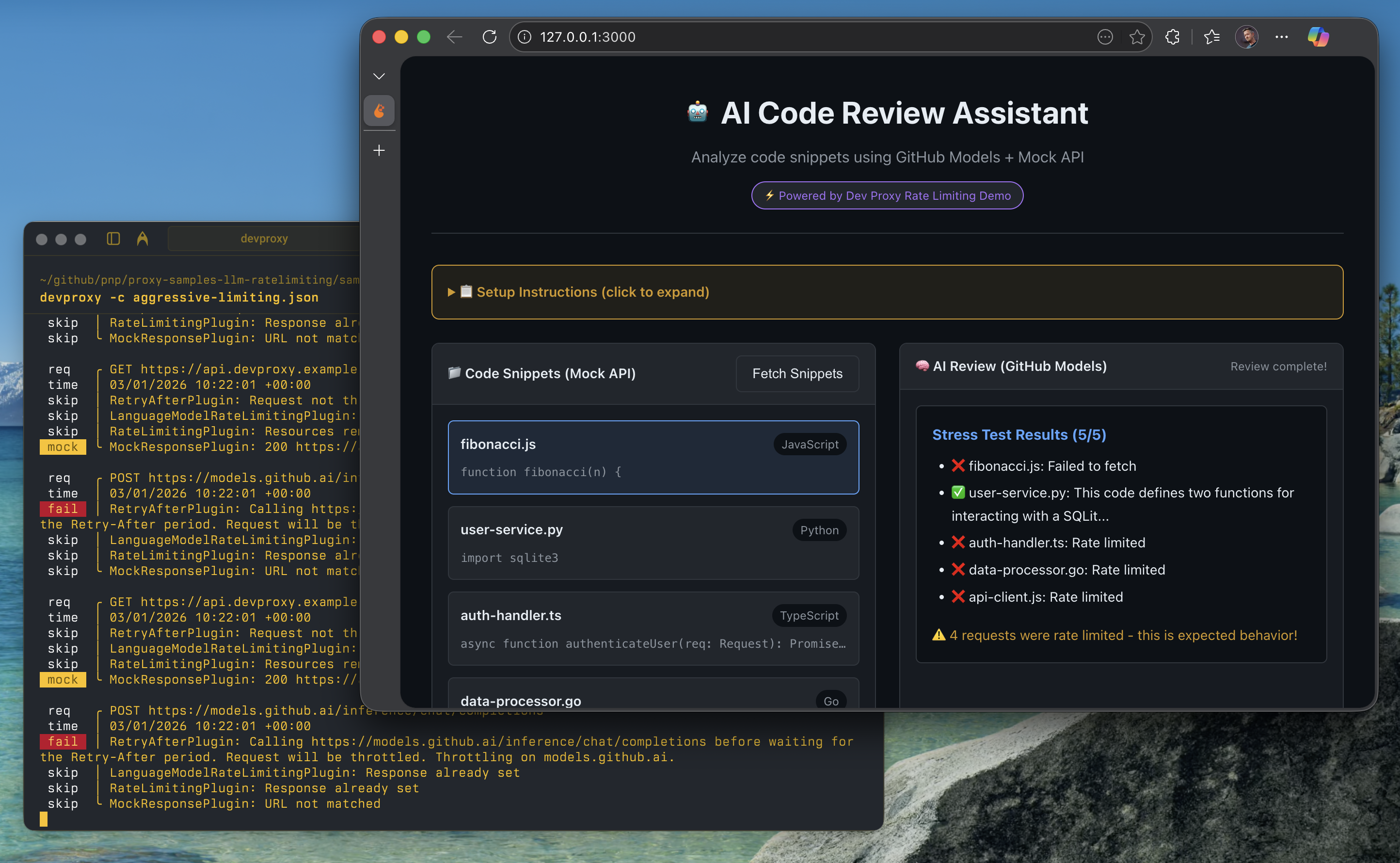
Successful code review:
Rate limiting in action (stress test):
Dev Proxy console output:
What the app shows
- 📊 Real-time rate limit status - See remaining requests/tokens
- 🚦 Visual indicators - Green/yellow/red status for rate limits
- ⚠️ Error handling - How throttling errors appear to users
- 🔄 Stress testing - “Review All” button to rapidly consume limits
Sample code snippets
The demo includes intentionally problematic code to make AI reviews interesting:
- SQL injection vulnerability (Python)
- Hardcoded secrets (TypeScript)
- Inefficient algorithms (JavaScript)
- Error handling issues (Go)
Configuration files
| File | Description |
|---|---|
devproxyrc.json | Main configuration with production-like limits |
aggressive-limiting.json | Recommended for demo - Low limits for quick testing |
api-mocks.json | Mock responses for the code snippets API |
index.html | Interactive demo app (AI Code Review Assistant) |
Rate Limits Summary
| Config | API Requests | Token Limits (prompt/completion) | Reset Window |
|---|---|---|---|
devproxyrc.json | 10/min | 1000/500 | 60s |
aggressive-limiting.json | 5/30s | 100/50 | 30s |
Features
This sample demonstrates the following Dev Proxy capabilities:
LanguageModelRateLimitingPlugin
Simulates token-based rate limiting for LLM APIs:
- Prompt token limit: Maximum number of input tokens allowed per time window
- Completion token limit: Maximum number of output tokens allowed per time window
- Token tracking: Monitors actual token consumption from API responses
- Throttling behavior: Returns 429 responses when token limits are exceeded
RateLimitingPlugin
Simulates request-based rate limiting for traditional APIs:
- Request cost: Configurable cost per request
- Rate limit headers: Exposes
X-RateLimit-Limit,X-RateLimit-Remaining, andX-RateLimit-Resetheaders - Warning threshold: Starts returning rate limit headers when threshold is exceeded
- Throttling behavior: Returns 429 responses when request limits are exceeded
MockResponsePlugin
Provides mock API responses for the code snippets service:
- Returns sample code snippets without needing a real backend
- Demonstrates how Dev Proxy can simulate complete APIs
RetryAfterPlugin
Ensures that when your application receives a throttled response, subsequent requests made before the retry-after period expires are also blocked.
Real-world scenarios
Scenario 1: LLM-powered code review tool
The demo app simulates a realistic workflow:
- Fetch code snippets from a repository API
- Send code to an LLM for analysis
- Display results to the user
Both APIs have rate limits - use this sample to test all failure modes.
Scenario 2: Cost-conscious development
During development, you want to ensure your application:
- Gracefully handles rate limiting without crashing
- Implements proper retry logic with exponential backoff
- Shows appropriate user feedback when limits are reached
- Doesn’t waste tokens on retries that will fail
Scenario 3: Production readiness testing
Before deploying to production, test your application against realistic limits:
- Use the default configuration to simulate typical production limits
- Use aggressive limiting to stress-test your retry logic
- Use custom responses to verify error handling
Troubleshooting
Requests aren’t being intercepted
Dev Proxy registers as a system proxy when started. If requests aren’t being intercepted:
- Verify Dev Proxy is running - Check the console output shows “Dev Proxy Listening on 127.0.0.1:8000…”
- Check system proxy settings - Verify Dev Proxy is registered as your system proxy
- Browser-specific issues - Some browsers may need to be restarted to pick up proxy changes
See the Dev Proxy troubleshooting guide for more details.
Tips for testing
- Watch the Dev Proxy output: It shows when tokens are consumed and when limits are exceeded
- Use the aggressive config: Makes it easy to trigger both types of rate limiting quickly
- Try the stress test: Click “Review All” to see what happens when you hit limits rapidly
- Check the status bar: The demo app shows real-time rate limit information
For more information about the configuration options, see:
- LanguageModelRateLimitingPlugin documentation
- RateLimitingPlugin documentation
- MockResponsePlugin documentation
- RetryAfterPlugin documentation
Help
We do not support samples, but this community is always willing to help, and we want to improve these samples. We use GitHub to track issues, which makes it easy for community members to volunteer their time and help resolve issues.
You can try looking at issues related to this sample to see if anybody else is having the same issues.
If you encounter any issues using this sample, create a new issue.
Finally, if you have an idea for improvement, make a suggestion.
Disclaimer
THIS CODE IS PROVIDED AS IS WITHOUT WARRANTY OF ANY KIND, EITHER EXPRESS OR IMPLIED, INCLUDING ANY IMPLIED WARRANTIES OF FITNESS FOR A PARTICULAR PURPOSE, MERCHANTABILITY, OR NON-INFRINGEMENT.